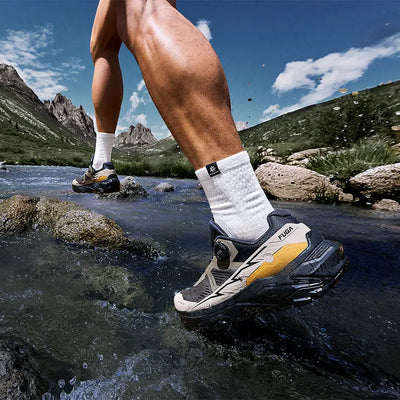
Trail racing combines speed, endurance, technical skill, and the challenge of navigating unpredictable natural terrain. Unlike road racing, trail competitions can take runners across rocky paths, dirt tracks, steep climbs, loose gravel, forest routes, muddy sections, and technical mountain surfaces. These changing conditions make specialized footwear an important part of race preparation. Kailas FUGA trail racing shoes are designed for runners who want dedicated off-road footwear with a focus on traction, comfort, stability, and responsive performance.
The Kailas FUGA family includes different trail running models designed around various terrain and distance requirements. Depending on the model, the collection includes features such as Vibram Megagrip outsoles, Litebase technology, engineered mesh uppers, specialized cushioning systems, BOA Fit System options, and waterproof GORE-TEX constructions. These features are intended for different types of trail adventures rather than a single type of race.
For runners searching for Kailas FUGA trail racing shoes, the key consideration is finding the model that matches the race environment. A fast mixed-terrain course may require a different combination of weight and traction than a steep mountain race. Understanding the differences between terrain, distance, cushioning, grip, and fit can help runners make a more informed footwear decision.
Kailas FUGA Trail Racing Shoes for Speed and Grip
The Kailas FUGA trail racing shoes range is designed to provide a balance between responsive movement and dependable traction. Trail racing often requires runners to change pace and direction while dealing with uneven ground. A suitable racing shoe should therefore feel responsive without sacrificing the grip needed to move confidently across natural surfaces.
One of the most important components is the outsole. Several FUGA models use Vibram Megagrip technology, which is designed to provide traction on demanding surfaces. Trail races can move from hard-packed dirt to gravel, rocks, roots, or wet ground within the same course. An outsole designed for trail use can help runners maintain a more reliable connection with the ground.
The exact outsole construction varies between FUGA models, making course conditions an important consideration. A trail racing shoe designed for muddy terrain may use a different lug configuration from footwear intended for compact mixed trails. Runners should therefore consider the surface they expect to encounter rather than choosing a shoe based solely on its brand or appearance.
Weight can also influence the racing experience. Lightweight Kailas FUGA trail racing shoes can provide an agile and responsive feeling, which may be useful on fast and runnable sections. However, the lightest option is not automatically the best option for every race. Technical terrain may require more protection and stability, while longer races can place greater emphasis on cushioning and comfort.
The upper construction also contributes to performance. Depending on the model, Kailas uses engineered mesh or multidimensional mesh materials designed to balance breathability and durability. This can be useful for runners who need ventilation during warm conditions while still requiring footwear capable of handling outdoor terrain.
Kailas FUGA Trail Racing Shoes for Technical Terrain
Technical trail races can place significant demands on footwear. Rocky paths, steep descents, loose surfaces, exposed roots, and narrow mountain routes require a shoe that provides grip and a secure feeling underfoot. Kailas FUGA trail racing shoes for technical terrain can be considered by runners who need specialized footwear for more complex routes.
The FUGA DU series is designed around steep and complex terrain. Models such as the FUGA DU MONSTER combine trail-focused outsole construction with specialized midsole and upper technologies. Kailas positions the FUGA DU MONSTER for steep and complex terrain, making it particularly relevant to runners searching for technical mountain trail footwear.
Protection is another important consideration during technical races. Running across rocky surfaces for extended periods can expose the feet to repeated contact with uneven ground. A protective midsole construction can help create a barrier between the foot and the trail, while a secure upper can help prevent excessive movement inside the shoe.
Stability can also influence confidence. Technical trails frequently require runners to make quick adjustments while climbing, descending, or navigating uneven surfaces. A stable platform can help provide a more controlled feeling, particularly when the course becomes difficult.
Weather conditions can further change the requirements of a trail race. Wet rocks and muddy paths can reduce traction, making outsole performance particularly important. Kailas also offers FUGA models with GORE-TEX waterproof membranes for runners who expect wet or cold conditions. These designs can be useful for races where water protection is more important than maximum ventilation.
Kailas FUGA Trail Racing Shoes for Long-Distance Events
Trail races can range from short, fast competitions to ultra-distance challenges that continue for many hours. The longer the event, the more important comfort, cushioning, durability, and fit can become. Kailas FUGA trail racing shoes for long-distance running include models designed for runners who need a combination of comfort and trail performance over extended distances.
The FUGA EX 330 is positioned by Kailas for ultra-long-distance mixed terrain. It combines a multidimensional mesh upper, supercritical foam midsole, and Vibram Megagrip outsole with Traction Lug and Litebase technology. This type of construction is relevant for runners searching for Kailas FUGA ultra trail racing shoes, long-distance trail shoes, and footwear for demanding mixed-terrain races.
Cushioning can become particularly valuable as race distance increases. A responsive and comfortable midsole may help runners maintain a consistent stride throughout a long event. However, cushioning preferences are personal. Some runners prefer a softer ride, while others prefer a firmer and more responsive platform.
Fit is equally important. A trail racing shoe should hold the heel and midfoot securely while allowing enough space around the toes for comfortable movement. During longer races, small fit problems can become more noticeable, so runners should take the time to find a size and shape that feels comfortable during training.
Breathability can also influence long-distance comfort. Mesh uppers can allow airflow and help manage heat, particularly in warm environments. Runners participating in colder or wetter races may instead prioritize water protection and weather-resistant construction.
Durability should not be ignored. Ultra and long-distance trail races expose shoes to rocks, dirt, moisture, roots, and repeated flexing. A durable trail racing shoe can provide greater confidence for runners who train frequently and compete on demanding routes.
Choosing Kailas FUGA Trail Racing Shoes for Your Race
Choosing Kailas FUGA trail racing shoes should begin with the course rather than the shoe itself. Understanding the terrain, distance, elevation, and expected weather can help determine the characteristics that matter most.
For fast and relatively smooth trail races, runners may prefer lightweight footwear with responsive cushioning and efficient traction. For technical mountain races, grip, stability, and protection can become higher priorities. For ultra-distance races, cushioning, comfort, breathability, and durability may be more important than simply reducing weight.
The FUGA EX series can be relevant for runners who want versatile mixed-terrain footwear, while the FUGA DU range is designed for more technical and steep environments. BOA-equipped models provide an adjustable fit system for runners who prefer micro-adjustable closure technology. GTX versions provide another option for runners who expect wet conditions.
Fit should remain central to the decision. A technologically advanced shoe will not provide the expected experience if it does not fit properly. Runners should consider foot shape, sock thickness, toe room, heel security, and overall comfort.
It is also useful to test new Kailas FUGA trail racing shoes during training before wearing them in an important competition. Running on terrain similar to the race course can help reveal whether the traction, cushioning, stability, and fit match the runner's needs.
There is no single FUGA model that is automatically ideal for every runner. The best choice depends on the specific course and the individual athlete. Matching the shoe to the environment can help create a more comfortable and confident racing experience.
Conclusion: Kailas FUGA Trail Racing Shoes for Confident Performance
Kailas FUGA trail racing shoes offer a specialized approach to off-road racing, with different models designed for mixed terrain, technical trails, long-distance events, and wet conditions. Depending on the model, the collection incorporates technologies such as Vibram Megagrip, Litebase, engineered mesh, specialized cushioning, BOA Fit System options, and GORE-TEX waterproof membranes.
Runners searching for lightweight trail racing footwear may prioritize responsiveness and low weight, while athletes competing on technical mountain routes may require stronger traction, stability, and protection. Ultra-distance runners may benefit from comfortable cushioning, durable construction, and a secure fit that remains comfortable over many hours.